
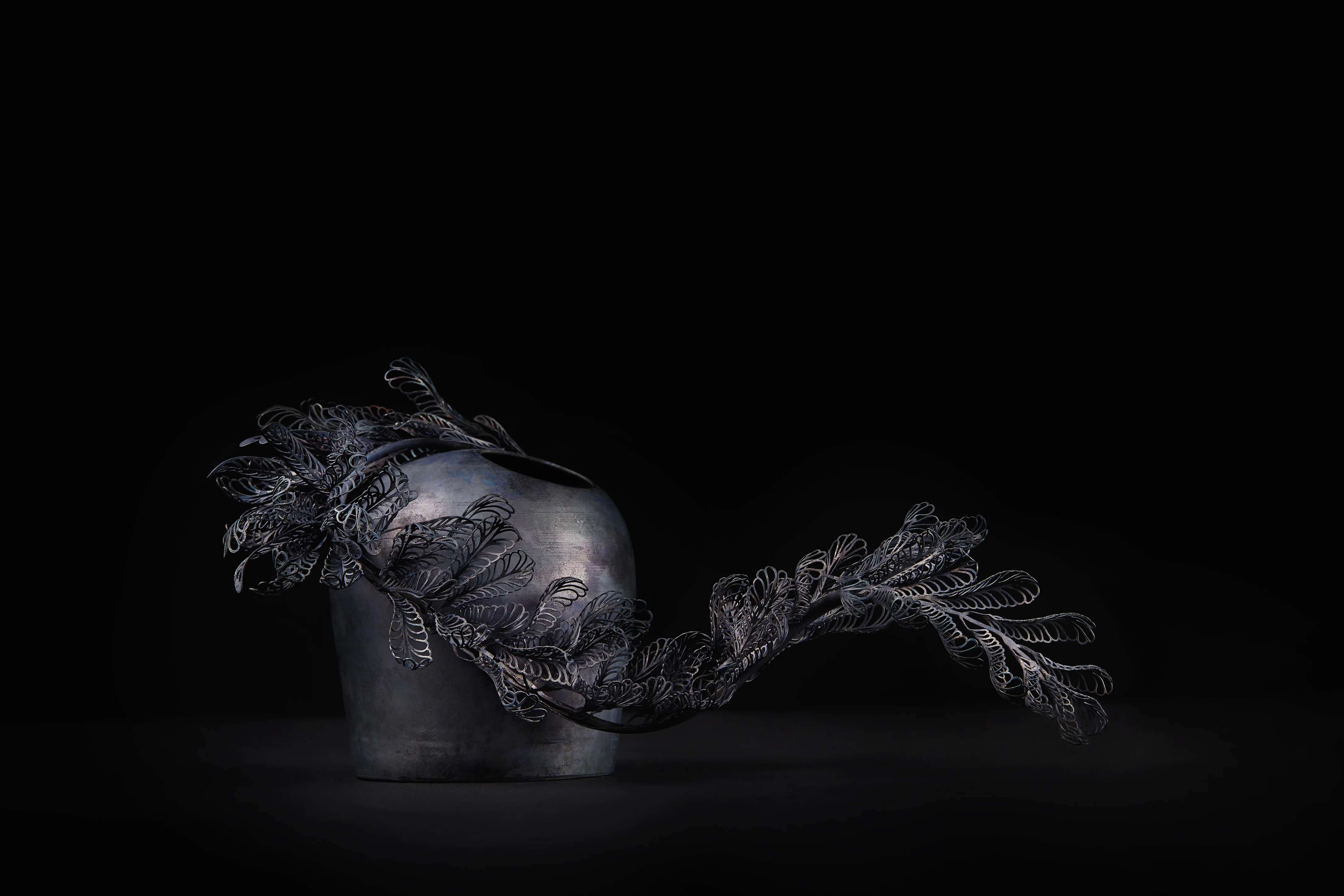
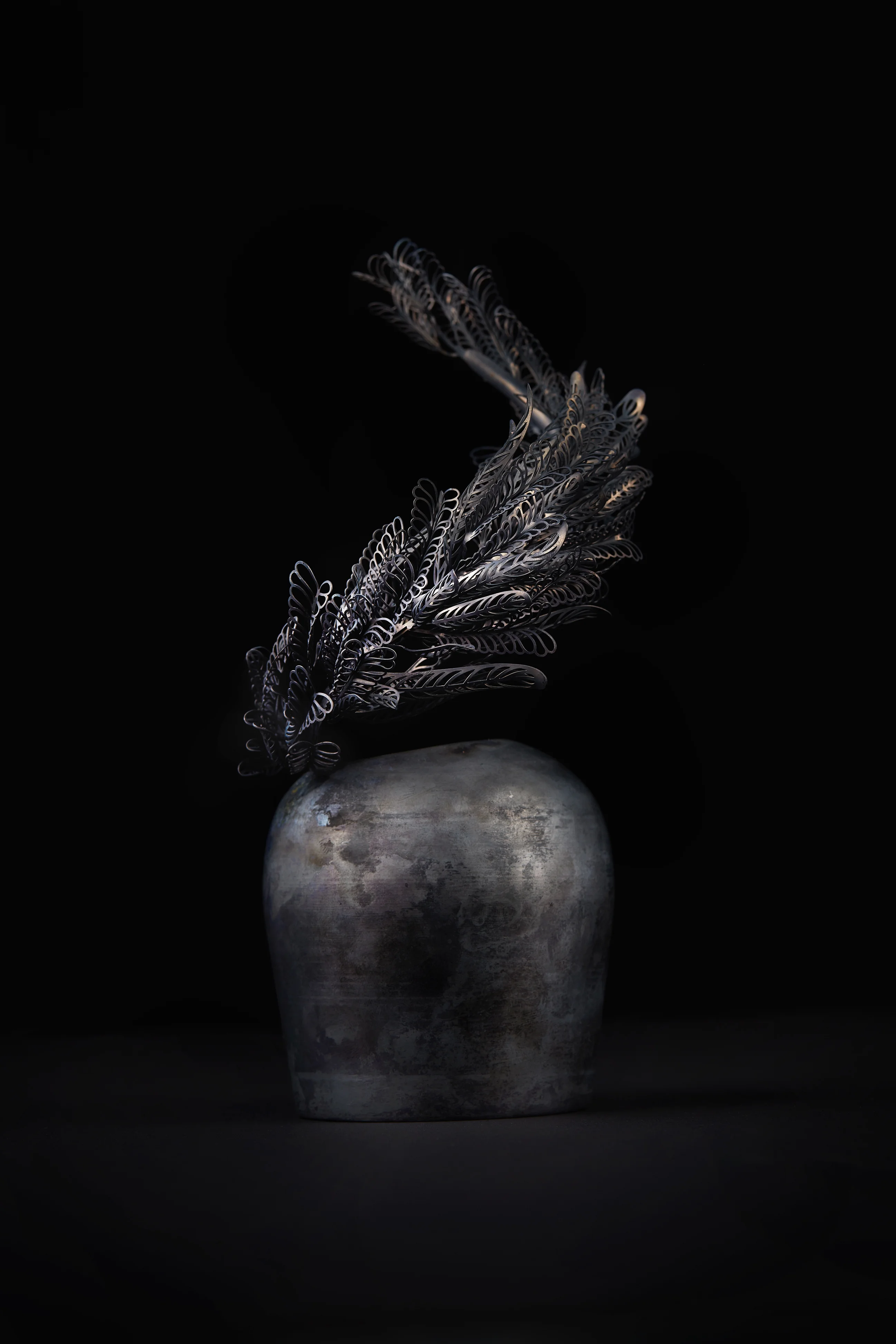
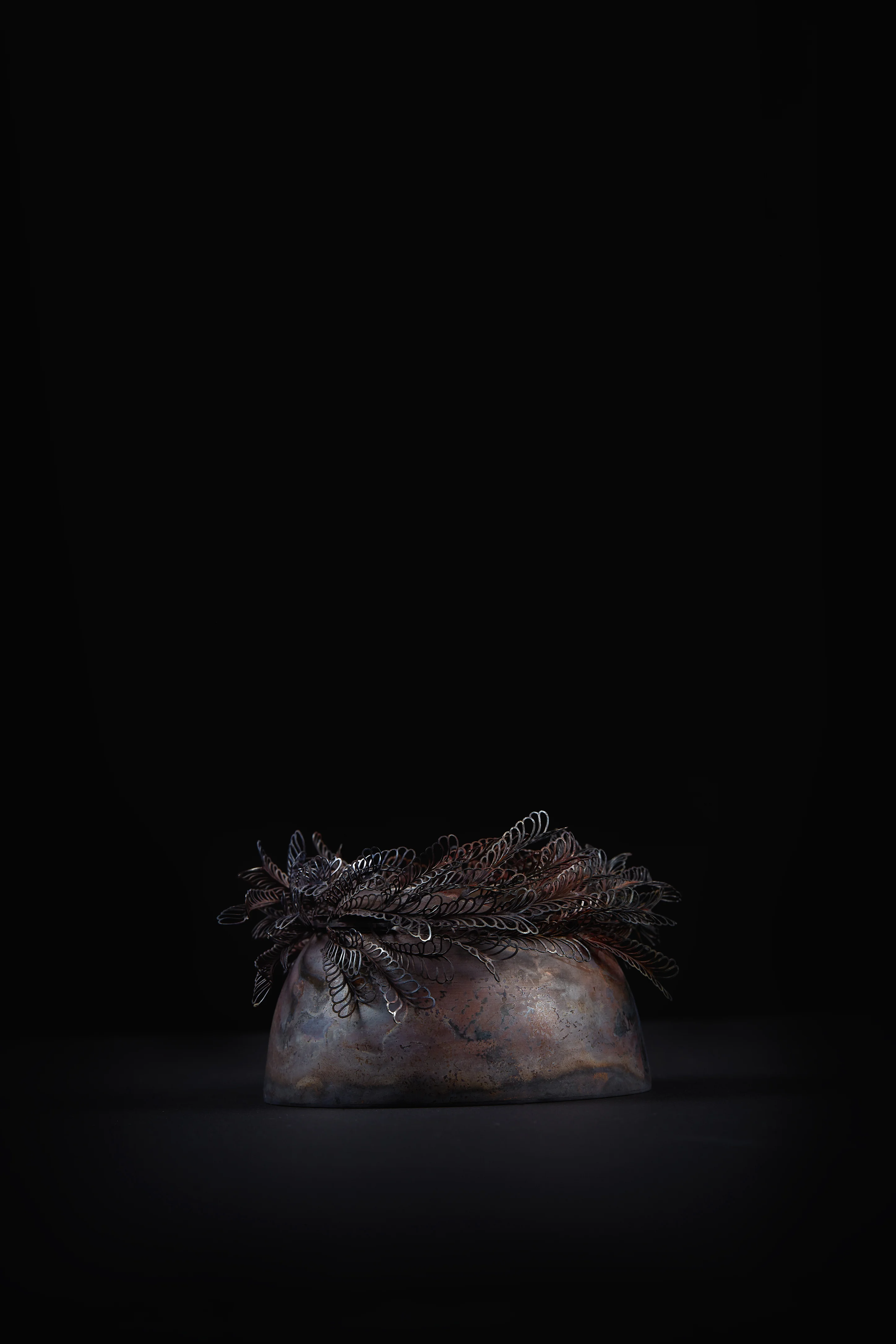
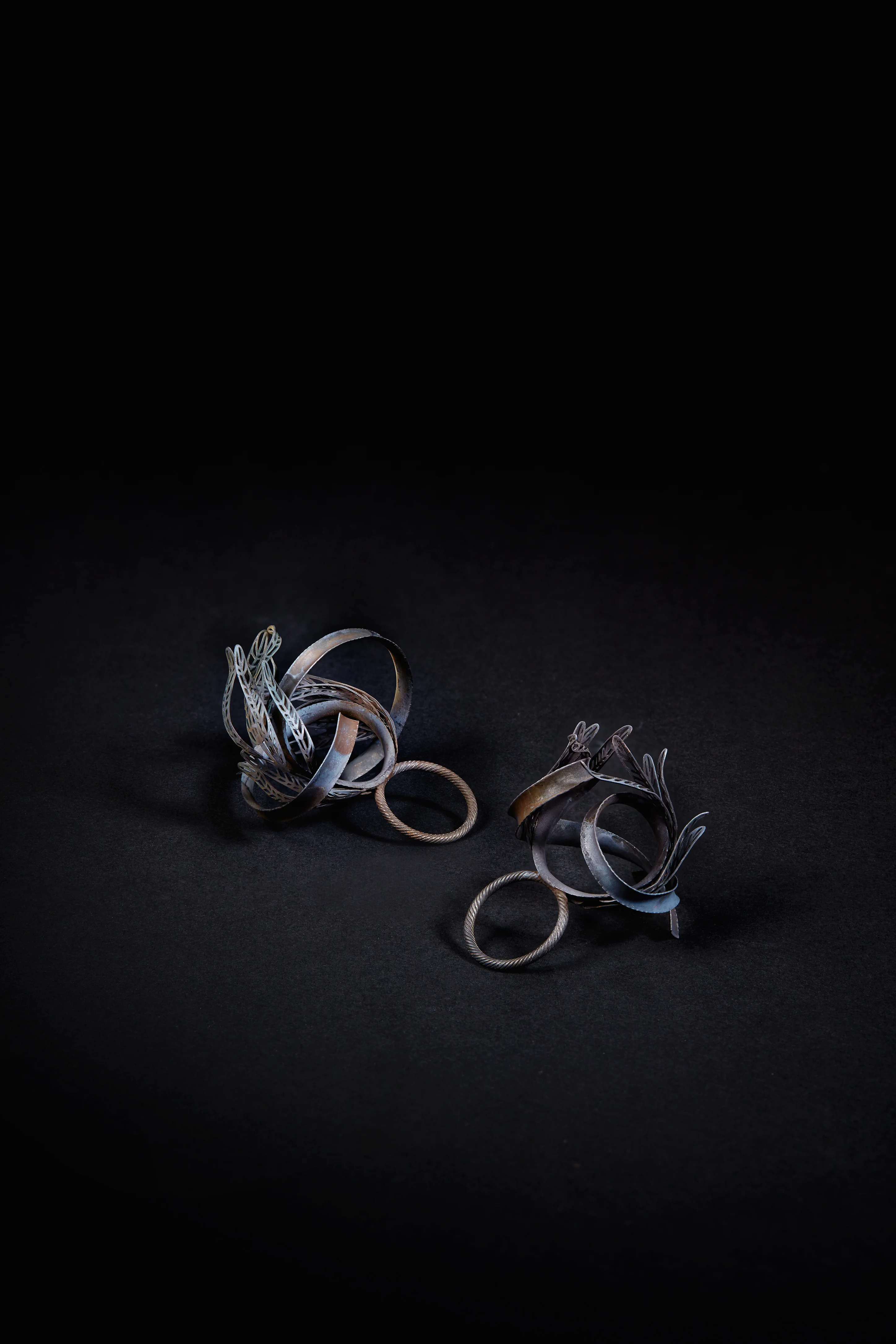
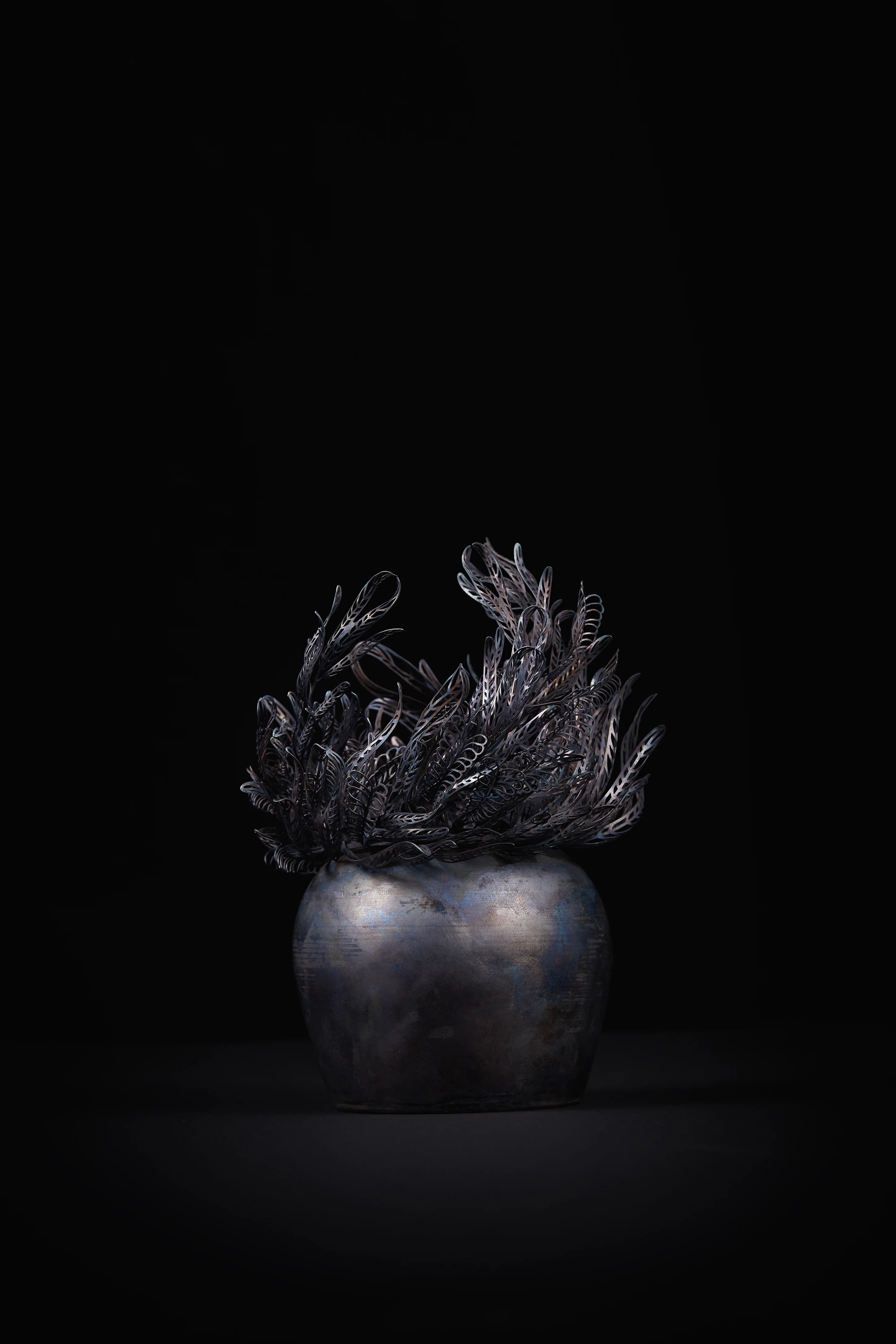
Over ten years, a private nocturnal practice of self-reckoning—restlessness, invention, expectation, dawning insight, and the quiet thrill of understanding—has accumulated into a personal line of thought. That interior trajectory is translated into forms resembling feather veins and leaf veins: ordered, yet never fully regular, carrying a postmodern sensibility through variation and deviation. It moves between the playful spirit of Memphis and the plural readings of deconstruction—organic, quasi-natural in texture—while retaining the unpremeditated candor of Chinese cursive calligraphy, where flying white (feibai) leaves breath in the stroke. Sincere and unbridled, the work composes complexity into a field of agitation: inspiration drifting, twisting, stretching, and leaping—an anatomy of unrest.
The making of the piece is not merely fabrication but inner fermentation—an alchemy through which process is sublimated into a visible state of mind, like a deep inhalation within the spirit. From the object, I speak to how design has rescued my thinking again and again—until it has become a form of faith. My innovation, my ideas, even my conviction: they bloom through the act of making.
Over ten years, a private nocturnal practice of self-reckoning—restlessness, invention, expectation, dawning insight, and the quiet thrill of understanding—has accumulated into a personal line of thought. That interior trajectory is translated into forms resembling feather veins and leaf veins: ordered, yet never fully regular, carrying a postmodern sensibility through variation and deviation. It moves between the playful spirit of Memphis and the plural readings of deconstruction—organic, quasi-natural in texture—while retaining the unpremeditated candor of Chinese cursive calligraphy, where flying white (feibai) leaves breath in the stroke. Sincere and unbridled, the work composes complexity into a field of agitation: inspiration drifting, twisting, stretching, and leaping—an anatomy of unrest.
The making of the piece is not merely fabrication but inner fermentation—an alchemy through which process is sublimated into a visible state of mind, like a deep inhalation within the spirit. From the object, I speak to how design has rescued my thinking again and again—until it has become a form of faith. My innovation, my ideas, even my conviction: they bloom through the act of making.
Hsin Lee’s work has a rare ability: she makes the invisible feel structurally real. Working with mirror-polished metals, titanium finishes, 316 stainless steel, nylon, and mixed media—often edged with the luster of jewelry relief, gold leaf, and crystal-like sparkle—she translates energy, time, humidity, and conviction into forms you can actually walk around, stand before, and sense in your body. Her practice lives in the in-between: stability and flux, matter and emotion, order and metamorphosis—held in a precise, deliberate tension.
In AUSPICIOUS, five supple branches become an introverted yet curious guardian of good fortune. It brushes the water curtain, steps lightly across a still surface, and lets its reflection drift outward—so a quiet, invisible steadiness seems to settle into the site. In Supercritical Fluid, she borrows the scientific language of phase states to speak about contemporary life: a stability produced by continual change, neither liquid nor gas, yet carrying the traits of both—an exact metaphor for living inside uncertainty. And in her Rooted Legacy works, she fuses the image of the tree with jewel-like surfaces: inheritance, roots, and memory set into a form that reads at once as a collectible object and as a place for the spirit to pause.
Hsin Lee isn’t simply making objects. She’s sculpting a shared sensation—letting the weight of the everyday catch the light, turning “steadiness” into something you can approach, and allowing belief to take root, quietly, inside form.