
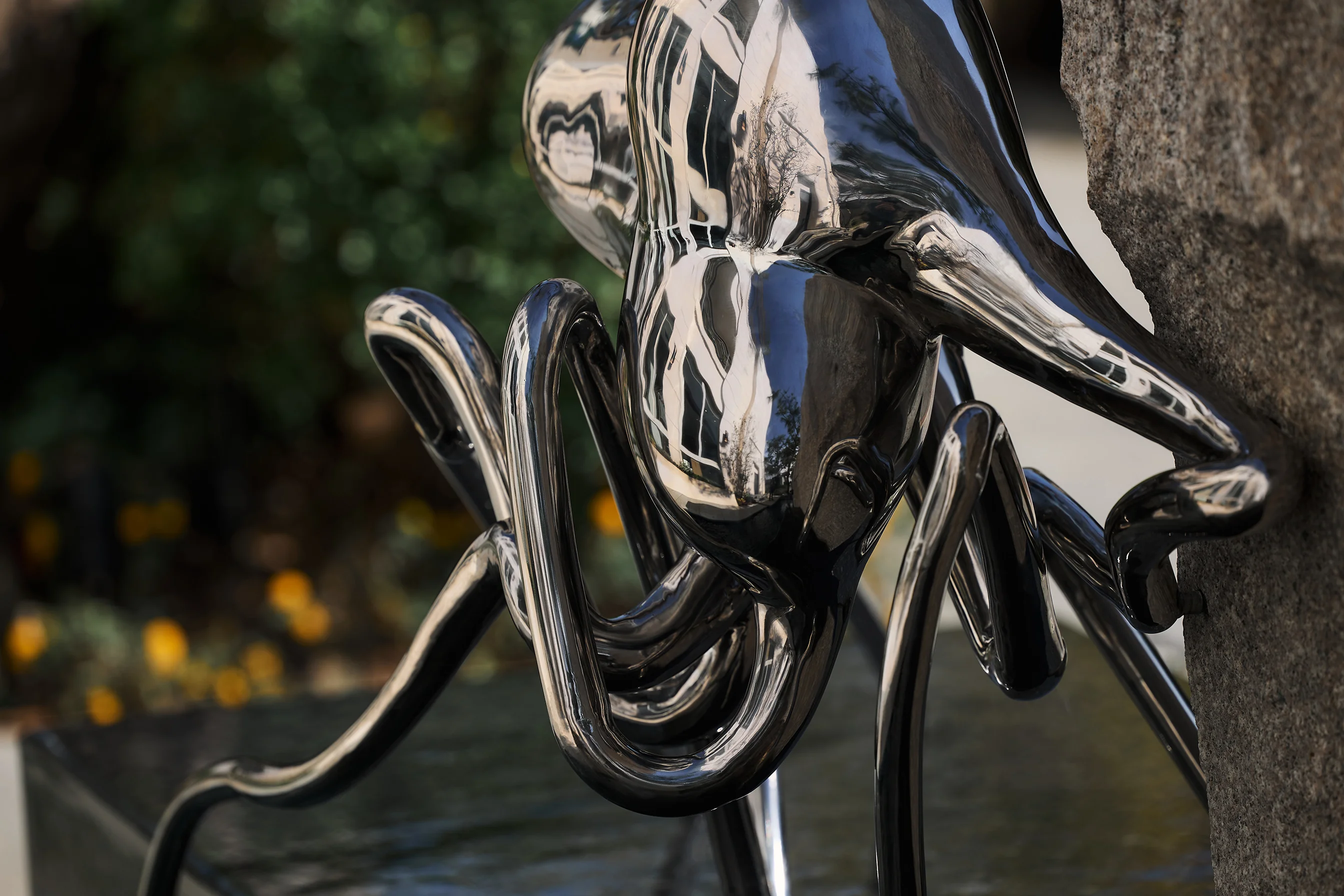
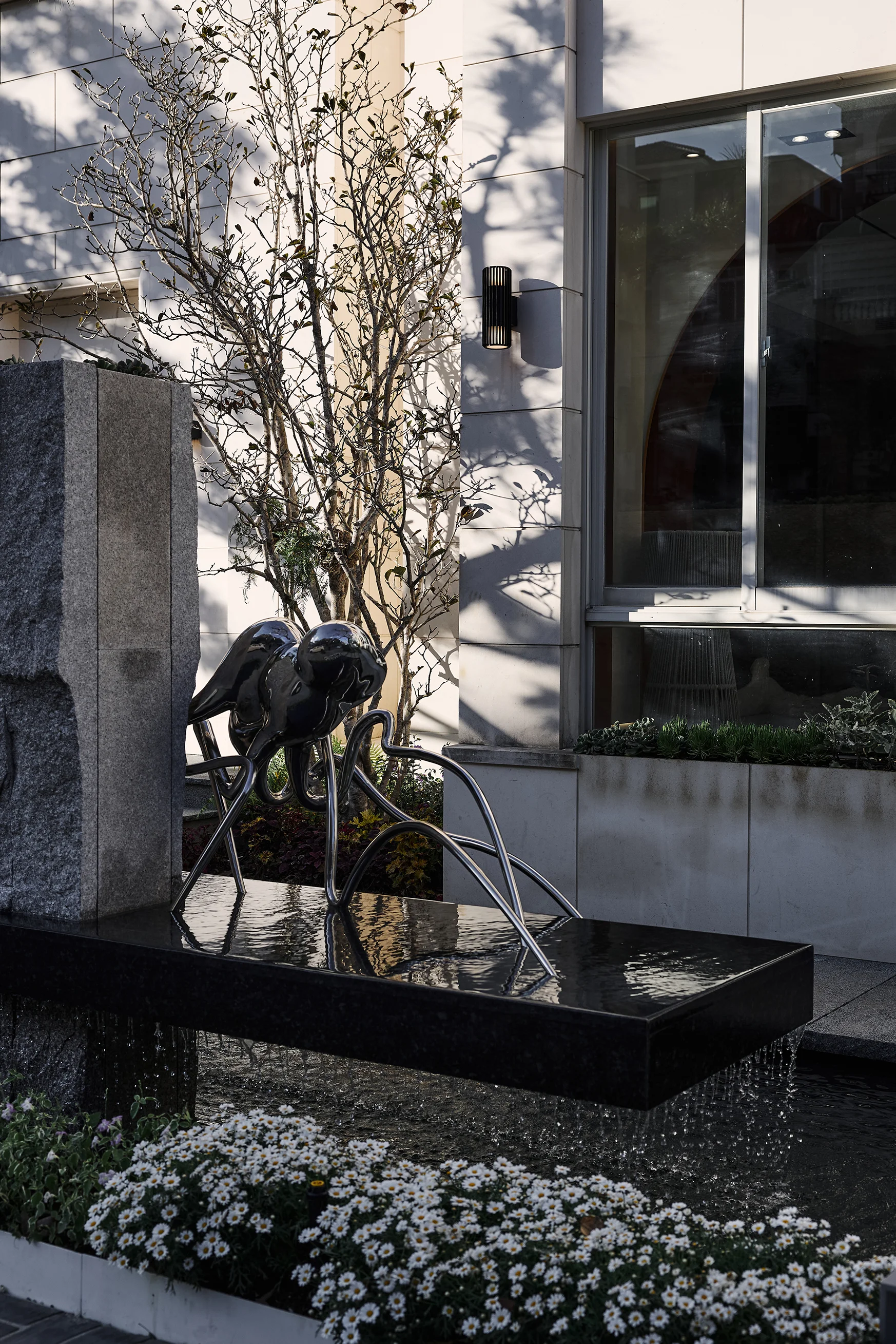
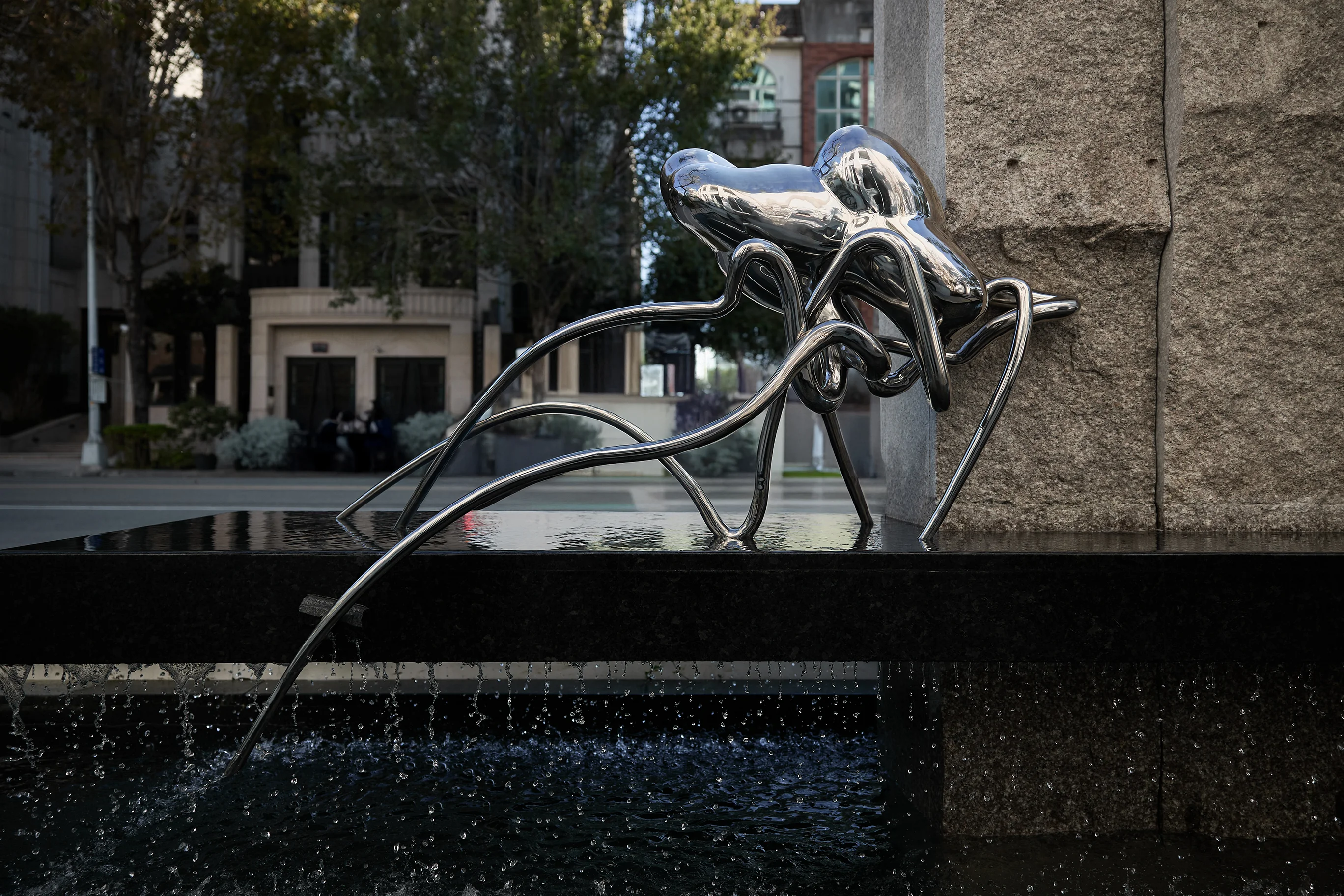
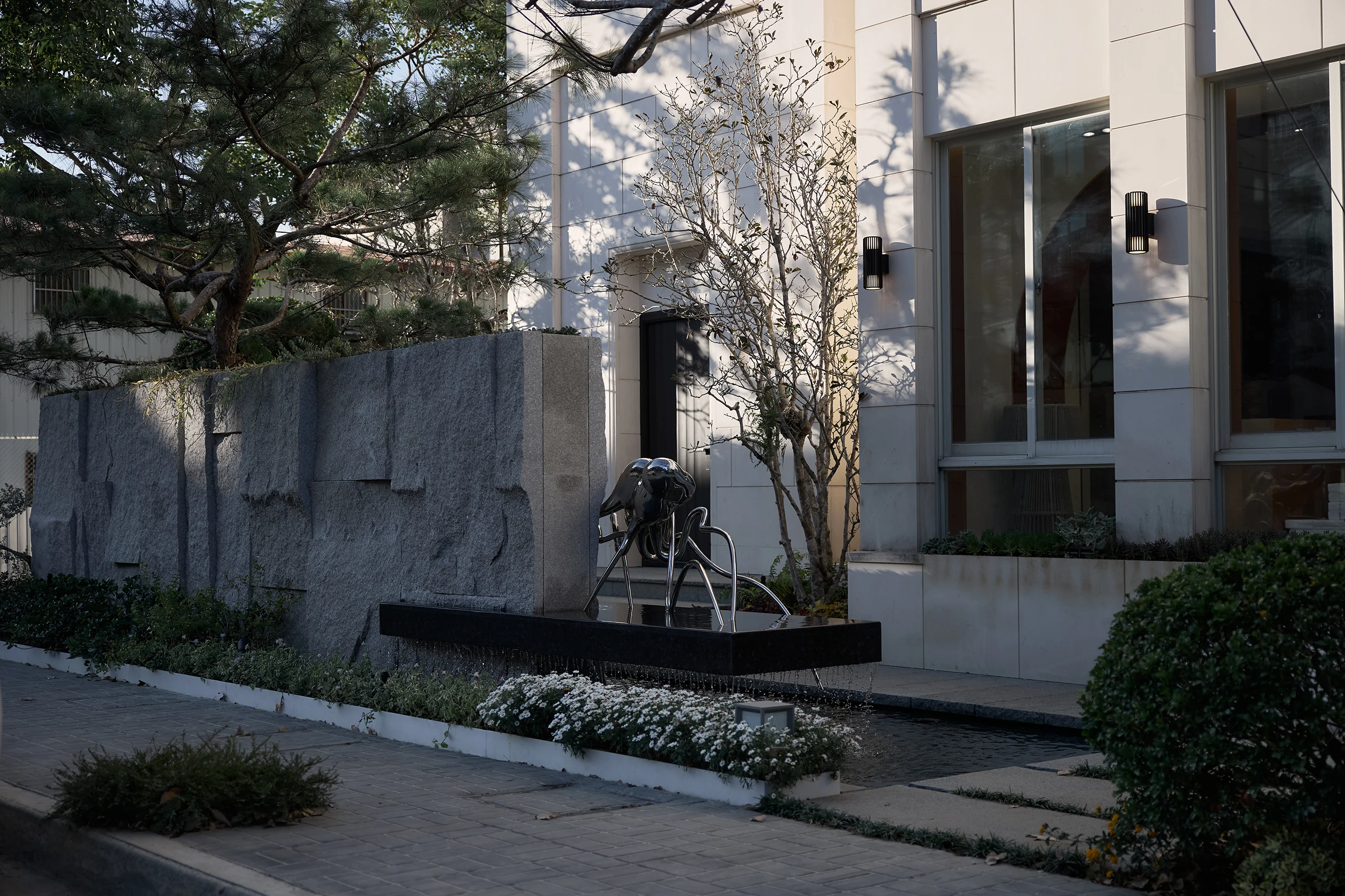
The cloud, a traditional emblem of good fortune, appears here as a five-branched form. While drawing in moisture, it leans outward to look—like an introverted yet curious guardian of auspice—resting at ease, gently teasing the water curtain, choosing to linger in this place.
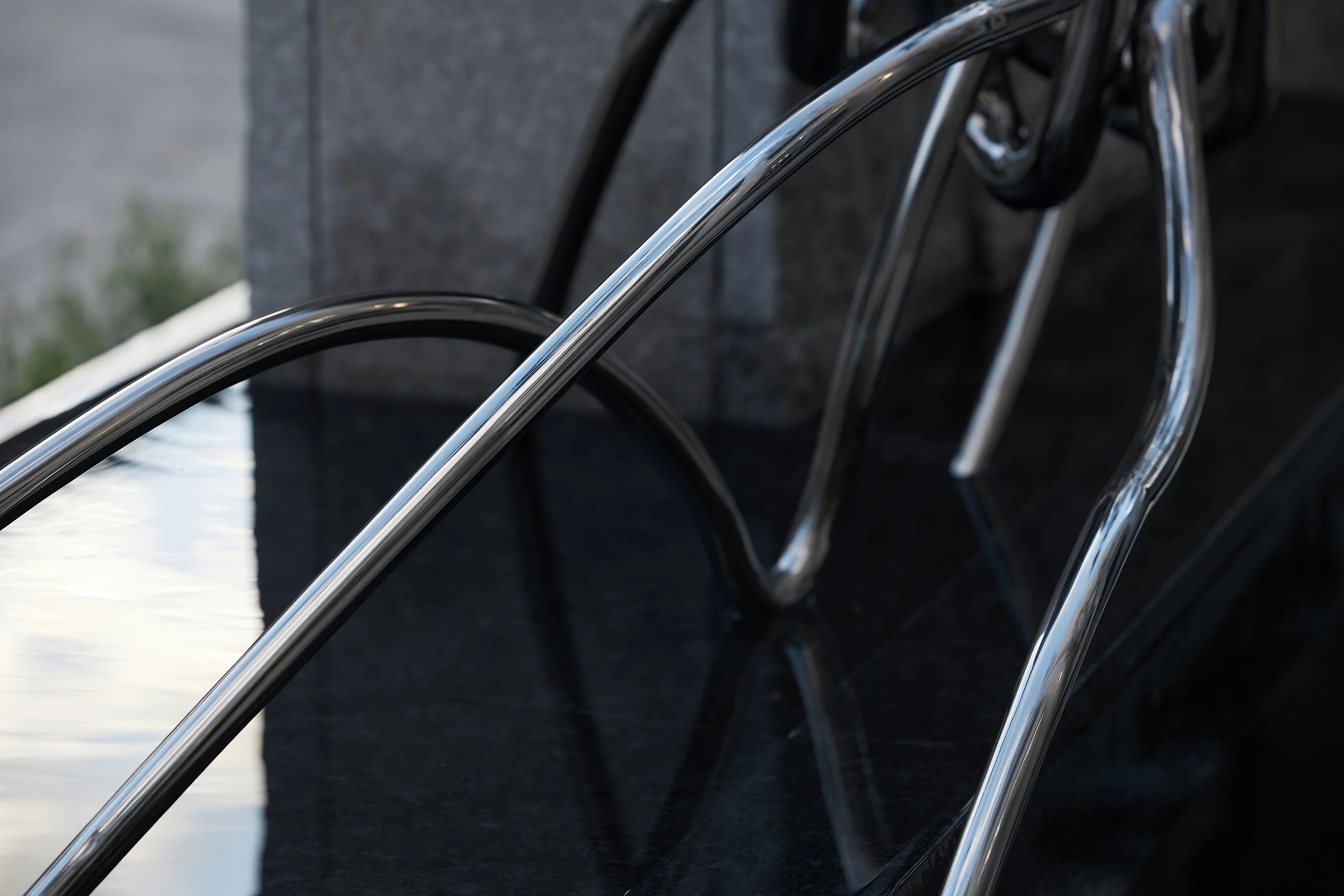
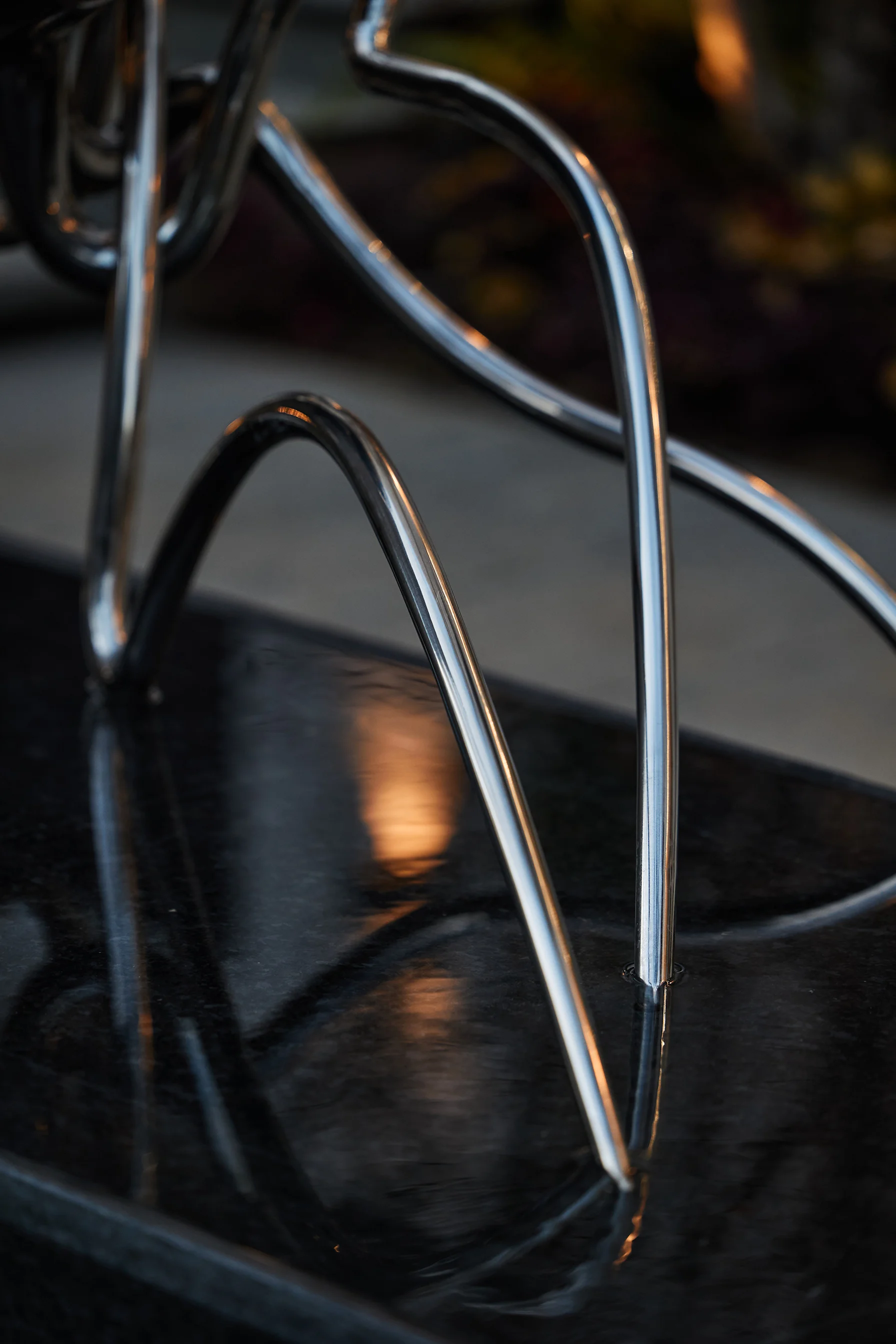
Its five branches are supple and agile: some fall softly, as if bending to whisper; others coil upward like vines in search of new life. They sway in small, almost breathing motions, as though catching the wind’s hush or the water’s quiet chime. Each branch holds a distinct temperament—contained, yet subtly alive.
AUSPICIOUS steps lightly across the still surface. Its reflection slides along the watery veil and drifts outward, as if the work were extending its presence into the surroundings. The cloud’s arrival carries an invisible steadiness—allowing this site to flourish as it once did, in a harmony of coexistence.
At first encounter, 五吉 seems to peek and probe, guiding the viewer through the route: from the elegance of its slender branches toward a sequence of striking transformations where its richer emotions come into view. This experience is unlike a conventional artwork. It belongs to artist Hsin Lee’s distinctive method of “Architectural Extension Art,” in which form continues through space and the site itself becomes part of the sculpture’s unfolding.
This series was first presented in May 2024 at National Taichung Theater, Tutu Hall.
The cloud, a traditional emblem of good fortune, appears here as a five-branched form. While drawing in moisture, it leans outward to look—like an introverted yet curious guardian of auspice—resting at ease, gently teasing the water curtain, choosing to linger in this place.
Its five branches are supple and agile: some fall softly, as if bending to whisper; others coil upward like vines in search of new life. They sway in small, almost breathing motions, as though catching the wind’s hush or the water’s quiet chime. Each branch holds a distinct temperament—contained, yet subtly alive.
AUSPICIOUS steps lightly across the still surface. Its reflection slides along the watery veil and drifts outward, as if the work were extending its presence into the surroundings. The cloud’s arrival carries an invisible steadiness—allowing this site to flourish as it once did, in a harmony of coexistence.
At first encounter, 五吉 seems to peek and probe, guiding the viewer through the route: from the elegance of its slender branches toward a sequence of striking transformations where its richer emotions come into view. This experience is unlike a conventional artwork. It belongs to artist Hsin Lee’s distinctive method of “Architectural Extension Art,” in which form continues through space and the site itself becomes part of the sculpture’s unfolding.
This series was first presented in May 2024 at National Taichung Theater, Tutu Hall.
Hsin Lee’s work has a rare ability: she makes the invisible feel structurally real. Working with mirror-polished metals, titanium finishes, 316 stainless steel, nylon, and mixed media—often edged with the luster of jewelry relief, gold leaf, and crystal-like sparkle—she translates energy, time, humidity, and conviction into forms you can actually walk around, stand before, and sense in your body. Her practice lives in the in-between: stability and flux, matter and emotion, order and metamorphosis—held in a precise, deliberate tension.
In AUSPICIOUS, five supple branches become an introverted yet curious guardian of good fortune. It brushes the water curtain, steps lightly across a still surface, and lets its reflection drift outward—so a quiet, invisible steadiness seems to settle into the site. In Supercritical Fluid, she borrows the scientific language of phase states to speak about contemporary life: a stability produced by continual change, neither liquid nor gas, yet carrying the traits of both—an exact metaphor for living inside uncertainty. And in her Rooted Legacy works, she fuses the image of the tree with jewel-like surfaces: inheritance, roots, and memory set into a form that reads at once as a collectible object and as a place for the spirit to pause.
Hsin Lee isn’t simply making objects. She’s sculpting a shared sensation—letting the weight of the everyday catch the light, turning “steadiness” into something you can approach, and allowing belief to take root, quietly, inside form.